
Blog · 20 November 2026
Robots in the workplace: what a small business can use now
Robots in the workplace for a small business: cleaning robots, robot waiters, cobots and humanoids, what makers say they cost, and a test before you buy.
By Andrei Satcau · Melbourne
Robots in the workplace aren't only a factory story any more. Robots that scrub floors, carry plates or mow lawns are sold in Australia, and some can be leased by the month. Below, as of 20 November 2026: what each kind suits and costs, what it can't do, what WorkSafe Victoria expects of you, and a short test before you spend anything.
The International Federation of Robotics (IFR) counted a record 5 million industrial robots working in factories in 2025. Service robots are counted apart: almost 250,000 professional service robots were shipped worldwide in 2025, and 47% of them were transport and logistics robots, the ones that move goods.
Which robots in the workplace suit a small business?
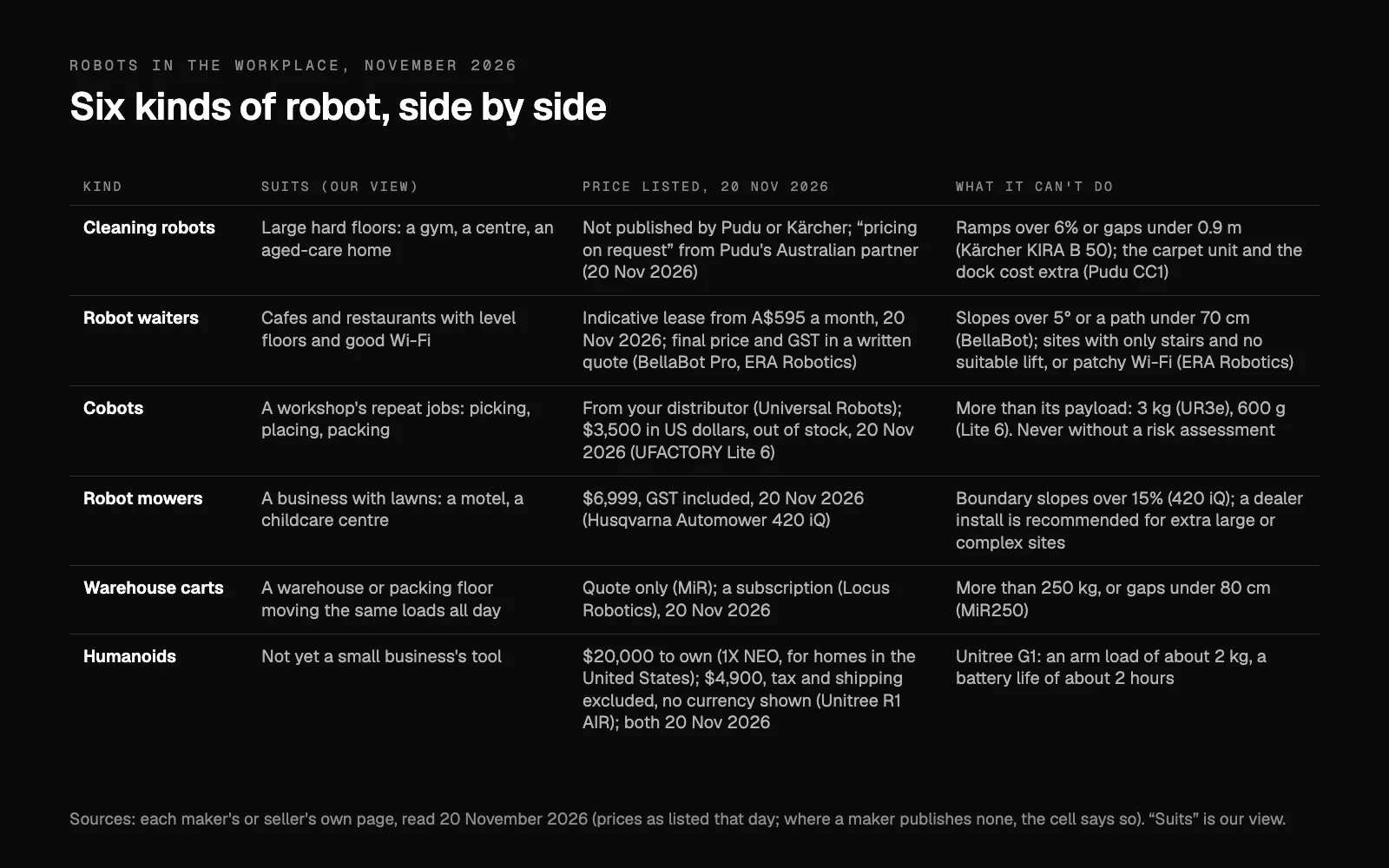
The table puts six kinds side by side; the business each suits is our view.
Are commercial cleaning robots worth it for a small site?
Pudu's CC1 does sweeping, scrubbing, vacuuming and mopping in one machine, covers 700 to 1,000 m² an hour, and scrubs for 5 hours on a charge, Pudu says. Its extension handle makes building the cleaning map easier, Pudu says. The carpet unit and the dock are bought separately.
They're built for big floors. ERA Robotics, Pudu's Australian partner, calls the CC1 well suited to multi-zone facilities with 5,000 m² or more to clean. Kärcher pitches its KIRA B 50 at medium to large areas: it climbs ramps of 6% at most and needs at least 0.9 m to pass. Neither maker publishes a price, and ERA lists the CC1 as "pricing on request". For a two-room clinic or a salon, we think a person with a good vacuum still makes more sense.
What can a robot waiter do in a cafe or restaurant?
A robot waiter carries plates out and empties back. Pudu's BellaBot has four trays, takes up to 10 kg a tray and 40 kg in all, runs about 13 hours with no load, and finds its way with lasers and cameras. Keenon's T10 fits through passages as tight as 59 cm, and guests can take their own plates from its open tray.
It needs a level, open floor. BellaBot climbs slopes of 5° at most and needs a 70 cm path. ERA says its delivery robots are not the right fit for sites with stairs only and no suitable lift, or with unreliable Wi-Fi where they deliver. In our view it saves walking, not a waiter: someone still loads the trays, and a staff member or the guest takes the plates off.
ERA Robotics' BellaBot Pro page gave an indicative lease from A$595 a month on 20 November 2026, with the final price and GST treatment confirmed in its written quotation. Its leases are fixed monthly payments, typically over 24 to 48 months.
For the admin after service, see AI for restaurants.
What is a cobot?
A cobot, or collaborative robot, is a robot arm made to work beside people. In the IFR's words, collaborative robots are designed to perform tasks in collaboration with workers. Universal Robots' UR3e carries 3 kg with a 540 mm reach. UFACTORY's Lite 6 carries 600 g, and UFACTORY says it suits jobs that don't need high accuracy.
"Collaborative" doesn't make it safe on its own. Universal Robots says every robot application requires a risk assessment, collaborative or not, and that the word describes the application, not the robot. The jobs we'd look at in a workshop are the dull, repeated ones: picking and placing parts, feeding a machine, packing.
UFACTORY listed the Lite 6 at $3,500 in United States dollars on 20 November 2026, when it showed as out of stock. Universal Robots publishes no price: its local distributors quote.
Robot mowers and warehouse carts
A business with lawns, like a motel or a childcare centre, can hand over the mowing. Husqvarna's Automower 420 iQ covers up to 4,000 m² and handles slopes up to 45%, but 15% at the lawn's boundary. Husqvarna recommends an authorised dealer installs it on extra large or complex sites.
Husqvarna's Australian store listed the Automower 420 iQ at $6,999, GST included, on 20 November 2026.
In a warehouse, a robot cart moves goods around the floor. MiR's MiR250 carries up to 250 kg and passes through spaces as narrow as 80 cm; its price is by quote. Locus Robotics rents its robots on a subscription billed annually. For transport and logistics robots, the IFR says buying is still the main way overall, but renting is already the dominant model in the United States.
Can you buy a humanoid robot yet, and what does it cost?
Humanoid robots get the headlines, but few are at work yet. The IFR counted about 7,000 full-size humanoids (above 140 cm, meant for commercial and professional use) sold worldwide in 2025, against more than 600,000 industrial robots installed that year.
1X takes orders for its NEO home robot at $20,000 to own, with deliveries in the United States from 2026, as listed on 20 November 2026.
Unitree's site listed its R1 AIR at $4,900, tax and shipping excluded, with no currency shown, on 20 November 2026.
Unitree gives its G1 an arm load of about 2 kg and a battery life of about 2 hours, and strongly advises buyers to understand the limitations of humanoid robots before they buy. Boston Dynamics says its Atlas deployments for 2026 are fully committed, with fleets going to Hyundai and Google DeepMind.
In our view, a humanoid isn't a small business purchase yet. If what you want is help on the front desk, check first whether the job that slips is the phone: see what an AI receptionist actually does.
What must an employer do when a robot works beside staff?
WorkSafe Victoria says plant includes any machinery, equipment, appliance, implement and tool, so in our reading a robot is plant. As an employer you must, so far as is reasonably practicable, provide and maintain safe plant, and make sure your business doesn't endanger other people, visitors and the public included. WorkSafe's plant guidance adds:
- Consult your staff when you identify or assess the risks, and when you decide how to control them.
- Get the controls right before first use, not after.
- Keep people and the machine apart where the risk calls for it. WorkSafe's examples of engineering controls include barriers and interlocked guarding.
Safe Work Australia names the risk plainly: a cobot moving unexpectedly and colliding with a worker. In September 2026 WorkSafe charged a department store and a robotics supplier after a 27-year-old man died at a warehouse where automated robots worked. Among other things, WorkSafe alleges access points were not guarded by an interlocked physical barrier.
A short test before you spend anything
Run these five questions on your own business first:
- Is the job the same every day? If it changes daily, we think a robot will struggle.
- Does your floor fit the robot? Measure doorways and aisles against the maker's minimum (70 cm for BellaBot, 0.9 m for the KIRA B 50, 80 cm for the MiR250), look for steps, check slopes against its limit, and check the Wi-Fi along the route.
- Who looks after it? Someone clears the path, calls the seller when it stops, and fills and empties the tanks unless a dock does it.
- Have you assessed the risks with your staff? Before it starts, not after.
- What's the total over the term? Ask for the lease length, what's excluded (GST, the dock, extra units) and a trial on your own floor.
If the hours you'd like back are at the desk rather than on the floor, start there: automation in business can begin with an AI that knows your services, your policies and your files, set up in your own account. If you already use ChatGPT or Claude, here's what changes when it's set up properly. Your free AI plan starts with eight questions.
Researched and drafted with AI, and checked line by line against its sources.
Questions people ask
Is a cobot safe to work beside?
Not just because it's called collaborative. Universal Robots, which makes cobots, says collaborative describes the application, not the robot on its own, and that every robot application requires a risk assessment, collaborative or not. Safe Work Australia names the risk of a cobot moving unexpectedly and colliding with a worker.
Can a small business rent a robot?
Some, yes. ERA Robotics, Pudu's Australian partner, leases serving robots on a fixed monthly payment, typically over 24 to 48 months, and Locus Robotics rents its warehouse robots on a subscription. For transport and logistics robots, the International Federation of Robotics says renting is already the dominant model in the United States.
Can you buy a humanoid robot?
A few. Unitree lists some of its humanoids with prices on its own site, and 1X takes orders for its NEO home robot, for delivery in the United States. The International Federation of Robotics counted about 7,000 full-size humanoids, meant for commercial and professional use, sold worldwide in 2025.
Do I need a risk assessment before using a robot at work?
In Victoria, WorkSafe expects employers to identify and assess the risks of any plant, consult their staff while they do it, and make sure the controls are right before using it for the first time. Universal Robots says every robot application requires a risk assessment.