
Blog · 11 November 2026
Missed calls: what an AI receptionist actually does
What an AI receptionist can and can't do for a Melbourne clinic or salon when nobody can pick up, and what to ask before you sign up for one.
By Andrei Satcau · Melbourne

It's one of the first things clinic owners tell us. Two of you are with clients, the phone rings three times, and nobody can get to it. Or it rings on a Sunday or a Monday, when nobody is in at all. Each of those calls might have been someone wanting to book, ask a question or move an appointment.
An AI receptionist is sold as the fix. Some are good, and some are a voicemail with a nicer voice. Here's what one actually does, what it doesn't, and what to check before you sign up.
What an AI receptionist is
It's a service that answers your phone with an AI voice when you can't. Your calls are forwarded to it, either all the time, after hours, or only when nobody picks up. It talks to the caller, answers common questions from information you give it, and then does something useful with the call: takes a proper message, texts a link, or books an appointment if it is connected to your booking system.
That last part is where most of the difference between products lies, and it depends more on your booking system than on the receptionist.
What it does well
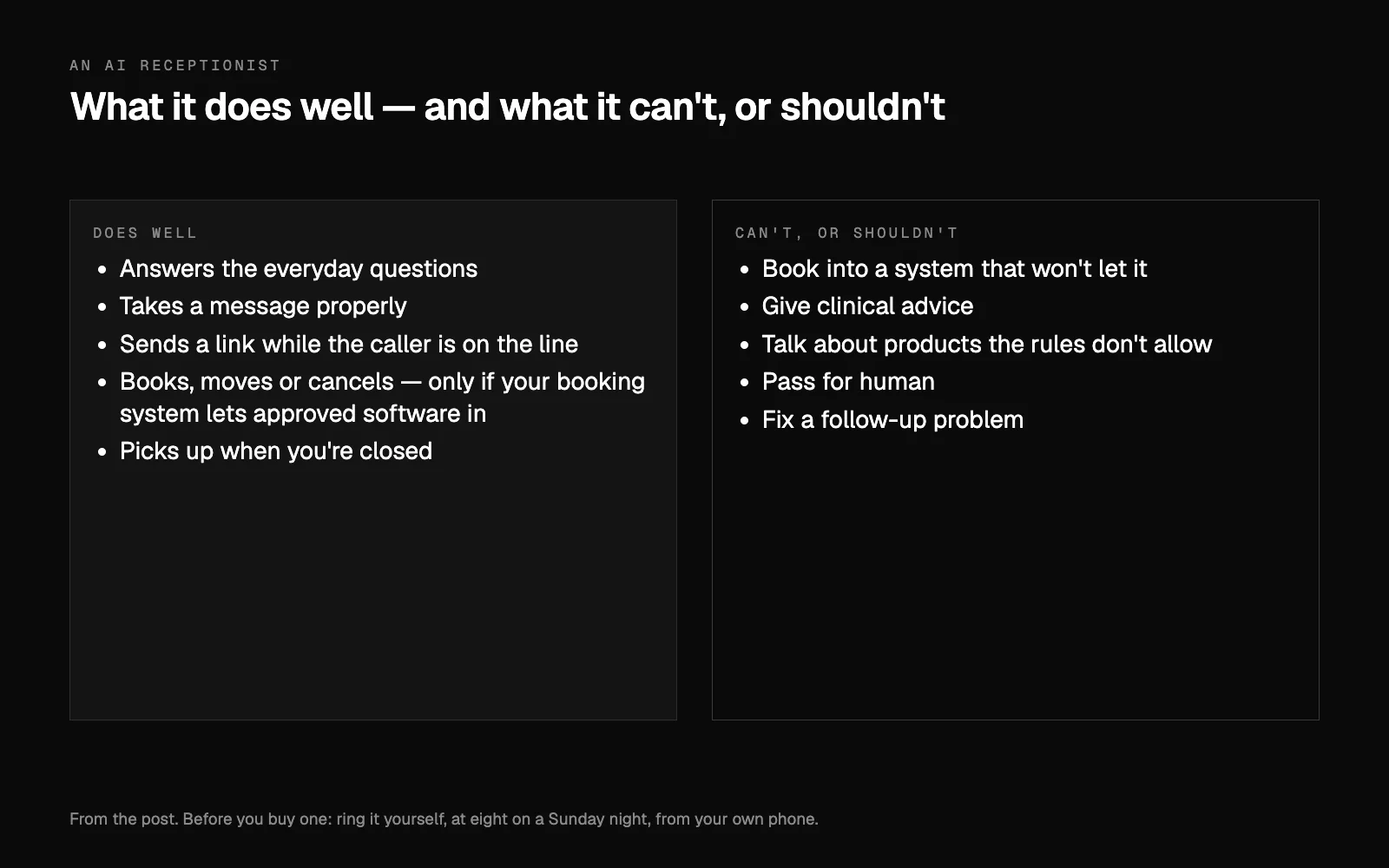
- Answers the everyday questions. Opening hours, the address and where to park, which services you offer, how long an appointment takes, whether there's a cancellation list. These come up again and again, and they have the same answers every time.
- Takes a message properly. Name, number, what they want and when suits them, sent to you as text you can read in a few seconds between clients, instead of a voicemail you have to play back.
- Sends a link. Your booking page, your intake form, your aftercare sheet, while the caller is still on the line.
- Books, moves or cancels appointments, but only when your booking system lets approved software in. Cliniko does; Fresha doesn't. We explain the difference in your booking system and AI.
- Picks up when you're closed. The Sunday and Monday calls get an answer and a next step instead of ringing out.
What it can't do, and shouldn't
- Book into a system that won't let it. Without an open connection it can only take the request and text your booking link. That's still useful, but it isn't a booking.
- Give clinical advice. In a health or cosmetic clinic the receptionist sticks to admin. Ahpra's guidance on AI says practitioners stay responsible for the AI tools they use, should tell patients when AI is involved, and must protect their privacy (Ahpra on AI in healthcare).
- Talk about products the rules don't allow. For cosmetic clinics there's another reason to keep the script tight: advertising rules for medicines apply to what you say to the public, so the script should describe consultations, not products (the TGA on advertising).
- Pass for human. Some owners tell us they can pick an AI voice within a second, and they worry their clients will too. That's a fair worry. The assistant should say what it is, sound clear and calm, and hand over to a person quickly when that's what the caller wants.
- Fix a follow-up problem. If callers already leave messages that nobody gets back to, an AI receptionist just collects more of them. The return call is still the job.
The parts that matter more than the voice
Most demos show off the voice. These are the parts that decide whether it works in your business:
- The handover. What happens with a question it can't answer? It should pass the caller to a person or take the details and send you the whole conversation, so nobody has to repeat themselves.
- What it knows. It's only as good as the information you give it: your services, your policies, how you like things said. Someone has to keep that current when your prices, hours or team change.
- Where the recordings go. Calls and transcripts are personal information. Ask where they are stored, who can see them and how long they are kept, and read how we handle your data for the questions we think every provider should answer.
- Who controls it. Can you change what it says yourself, see every call, and switch it off in a minute if something goes wrong?
- Ring it yourself first. At eight on a Sunday night, from your own phone, with the questions your clients actually ask.
A simpler first step for many businesses
Before a voice on the phone, a lot of businesses get more from the quieter fix: every missed call, website enquiry, DM and email getting a quick, accurate reply in writing, with a follow-up when nobody answers. It's less exciting than a talking assistant, but it's where a lot of the hours go, and it works with any booking system because it happens around the booking rather than inside it.
That's the kind of thing we build. The AI drafts the replies in your voice, a person approves anything that goes to a client, and every enquiry lands in one place so nothing goes cold.
How to decide
Answer three questions before you buy anything:
- How many calls do you actually miss, and when? Your phone's call log for one week tells you more than any sales page.
- Does your booking system connect? If it doesn't, an AI receptionist can answer and take details, but it can't book.
- What should the caller end up with? A booking, an answer, or a call back from you. Pick the tool that gets them there.
If you'd like a second opinion on which of these fits your business, your free AI plan starts with eight quick questions, and a written plan reaches your inbox the same business day, checked by a person first. Or book a 15-minute call and talk it through.
Researched and drafted with AI, and approved by Andrei.
Questions people ask
Will callers know they're talking to AI?
Often, yes, and they should: the assistant should say what it is at the start of the call. A clear voice that answers the basics and passes the rest to a person beats one pretending to be human.
Can an AI receptionist give medical or treatment advice?
It shouldn't. In a clinic it sticks to admin: hours, location, bookings, what to bring. Anything clinical goes to a practitioner, who stays responsible for any AI the clinic uses.
What if our booking system doesn't connect?
Then it can't book for you. It can still answer the call, take the details, text your booking link and pass the request to your team, which already beats a call that rings out.