Blog · 27 November 2026
Uncensored AI: the security risk to a small business
Uncensored AI, in plain words: what it is, why scam emails, fake invoices and impersonation get easier, and six things a small business can do about it.
By Andrei Satcau · Melbourne

Uncensored AI is an AI model with its refusals taken out, and the risk to a small business is not that you would use one. It is that a scammer can, which makes a convincing scam email, a fake invoice or a message "from the owner" easier to produce.
Below: what these models are, what they change, and six things an owner can do. Nothing here says how to make, find or use one.
What uncensored AI is
The companies that make AI assistants train them to refuse harmful requests. The International AI Safety Report 2026, published in February 2026, adds that no combination of safeguards is perfectly reliable.
Some AI models are released as "open-weight": the model's files can be downloaded. That is the kind of model you use when you run AI locally, and the UK's AI Security Institute calls open-weight systems "the lifeblood of open research and innovation in AI".
The catch is in the same post, from August 2025: safeguards "can also be quickly and cheaply removed from open-weight models", and once a system is released with open weights, it cannot be rolled back. An "uncensored" model is a copy someone has altered that way, to take its refusals out. "Abliterated models" are the same idea under another label.
They are not hard to come by. The Institute describes uncensored models as widely available, and "uncensored AI text generator" is a term people search for. This post names none of them.
Why uncensored AI matters to a small business
Because the person using it won't be you. The Australian Signals Directorate's Annual Cyber Threat Report 2025–26, published on 26 October 2026, says AI has amplified the effectiveness of social engineering techniques, "enabling malicious cyber actors to more convincingly impersonate or manipulate Australian individuals and businesses for financial gain or access to networks".
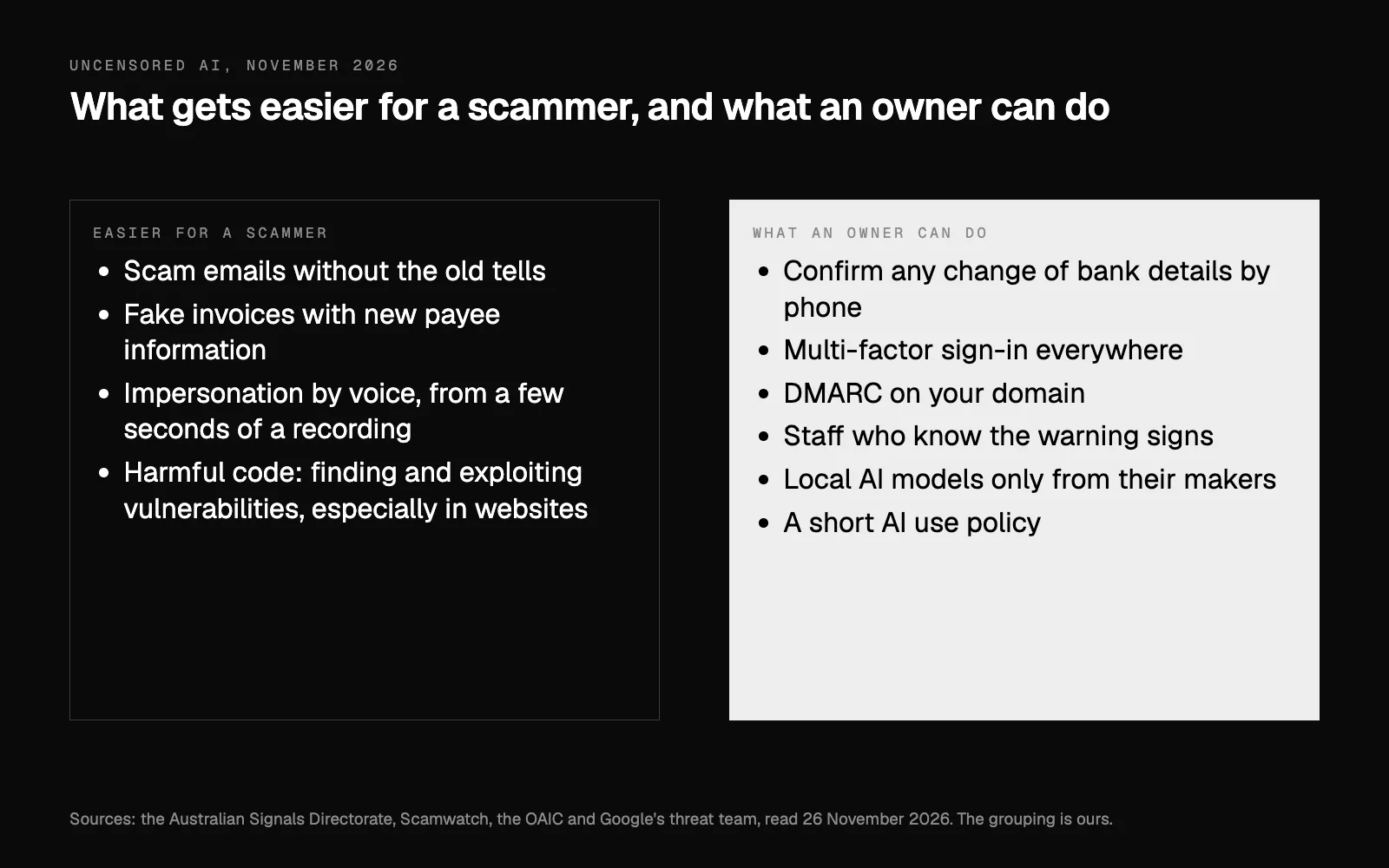
Four things get easier for a scammer:
- Scam emails without the old tells. Google's threat team wrote in February 2026 that people have long relied on signs such as poor grammar and awkward syntax to spot phishing, and that attackers increasingly use AI models to write lures that can mirror the professional tone of the organisation they target.
- Fake invoices. In the scam Scamwatch describes, scammers pretend to be from a business you've used and send you an invoice with new payee information. Scamwatch also says professional-looking official documents can be created in minutes.
- Impersonation by voice. Scamwatch says scammers can use a few seconds of a voice recording to create AI clones, and call pretending to be friends or family members in distress. We would assume an owner's or a supplier's voice is no harder to copy.
- Harmful code. The Directorate's guidance for small businesses, published in July 2026, says cybercriminals may use AI to rapidly discover and exploit vulnerabilities, especially in websites.
How much of that is down to uncensored models? Some, on the evidence so far. In February 2026 the AI Security Institute published tests of 14 AI models on fraud and cybercrime scenarios. Models fine-tuned to remove their safety guardrails gave substantially more harmful assistance than closed-weight, safety-aligned models, which consistently refused harmful requests.
But it concluded that current text-based AI models provide "limited operational uplift for fraud". Only 5 to 7 percent of outputs looked ready to use or showed signs of specialised insight, almost entirely from open-weight models with weakened or removed safety guardrails. It tested text only, not images, audio or video.
Uncensored models aren't the only route, either. Google's report says threat actors struggle to develop custom models and instead rely on mature ones, such as Google's own Gemini. So you can't tell which tool wrote an email, and you don't need to: the defences are the same.
AI scams: what a small business can do
Six things, none of them new. Each rests on an Australian Government page as it read on 26 November 2026. Where we go further, we say so.
- Confirm any change of bank details by phone. Scamwatch's step is to contact the business you normally deal with by phone, using a number you have sourced independently: the one already in your records, we would say. Don't use the contact details in the email, as the scammer might have changed them. We would make it a rule nobody skips, the owner included.
- Turn on multi-factor sign-in everywhere. The Directorate's handbook calls it one of the most effective ways to protect business accounts. It adds an extra step to logging in, such as a one-time code from an app, so a stolen password alone can't be used to get into an account. We would start with email, banking and the books.
- Put DMARC on your domain. DMARC is a setting on your domain that advises other mail servers what to do with email claiming to come from you. The Directorate's guidance on fake emails says to implement it, with SPF and DKIM, to stop criminals faking an email domain, and calls it critical. It notes that receiving mail servers need to be configured to honour it for the protection to be in effect.
- Tell staff what an impersonation looks like. The Directorate's warning signs: an unexpected change of bank details, an urgent payment request or threats of serious consequences if payment isn't made, unexpected payment requests from someone in a position of authority, and an email address that doesn't look quite right. Its handbook says to train staff to question unexpected requests, "even when messages appear professional, familiar or trustworthy". For a phone call, Scamwatch's advice is to call the organisation back on a number you find yourself.
- On any office computer that runs local AI, take models only from their makers. The Directorate's guidance on AI supply chains says to use models from trusted and reputable providers where possible, "a simple yet effective way to reduce the risk of poisoned or maliciously modified models", though it does not eliminate all risk. It also says malware can hide segments of code in a model's weights or metadata, which antivirus software may not typically check. Our rule is stricter: the maker's own. An altered copy from a stranger gives you two unknowns, we think: what it will now agree to do, and what else was changed. Our post on the computer you need for local AI lists five open models, each named with its maker.
- Write a short AI use policy. The Directorate's AI guidance for small business says to establish an internal AI use policy or process, and to clearly define what data can't be uploaded into AI platforms and systems. Australia's privacy regulator, the OAIC, says organisations should establish policies and procedures for the use of AI systems. One page will do, we think: which tools are approved, what never goes in, no models from unknown sources, and who to ask.
When uncensored AI is not your problem
Most of the time, we think. You don't need to find these models, test them or block them, and we wouldn't buy software that claims to spot AI-written email. The Directorate's threat report puts it this way: "AI capabilities have not introduced new cyber threats, but they have amplified existing ones". The six steps above are the defences against the existing ones.
Two steps may not apply. Step 5 can wait if nobody in your business runs AI on their own computer. Step 3 is for a business that sends email from its own domain.
If money has already gone, Scamwatch says to call your bank immediately to stop any further losses, and to report the scam.
Our data page says what we never do with a client's data, starting with this: we never train AI models on it. To see where AI fits in your business, your AI plan starts with eight questions.
Researched and drafted with AI, and checked line by line against its sources.
Questions people ask
What is uncensored AI?
An open AI model that someone has altered to remove its safety guardrails, the training that makes a model refuse harmful requests. The UK's AI Security Institute says safeguards can be quickly and cheaply removed from open-weight models, the kind whose files can be downloaded. 'Abliterated' is another label for the same idea.
Can a scammer really copy someone's voice with AI?
Scamwatch says scammers can use a few seconds of a voice recording to create an AI clone, and then call pretending to be friends or family members in distress. For a call from an organisation, its advice is to call back on a number you find yourself on the organisation's official website or app.
How do I check that a change of bank details is real?
Scamwatch says to stop and check any changes to payee information on invoices, and to contact the business you normally deal with by phone, using a number you have sourced independently. Don't use the contact details in the email, as the scammer might have changed them.
Should my business use an uncensored AI model?
We wouldn't. The Australian Signals Directorate's guidance is to use models from trusted and reputable providers where possible. It calls that a simple yet effective way to reduce the risk of poisoned or maliciously modified models, though it does not eliminate all risk.