
Blog · 11 November 2026
How AI consultants price their work in Australia
Fixed quotes, hourly rates and monthly retainers: how AI consultants in Australia price their work, what each suits, and the questions to ask first.
By Andrei Satcau · Melbourne

"How much does AI cost?" is a fair question, and the honest answer is that it depends on what you want it to do. What you can know up front is how a consultant prices the work, because that decides who carries the risk, what you can budget for, and what happens when the job changes halfway through.
There are three common ways AI consultants price work: by the hour or day, as a fixed quote for a defined piece of work, or as a monthly retainer. Some mix them. Here's how each one works, what it suits, and what to ask, without a single price in sight.
Paying for time: hourly or day rates
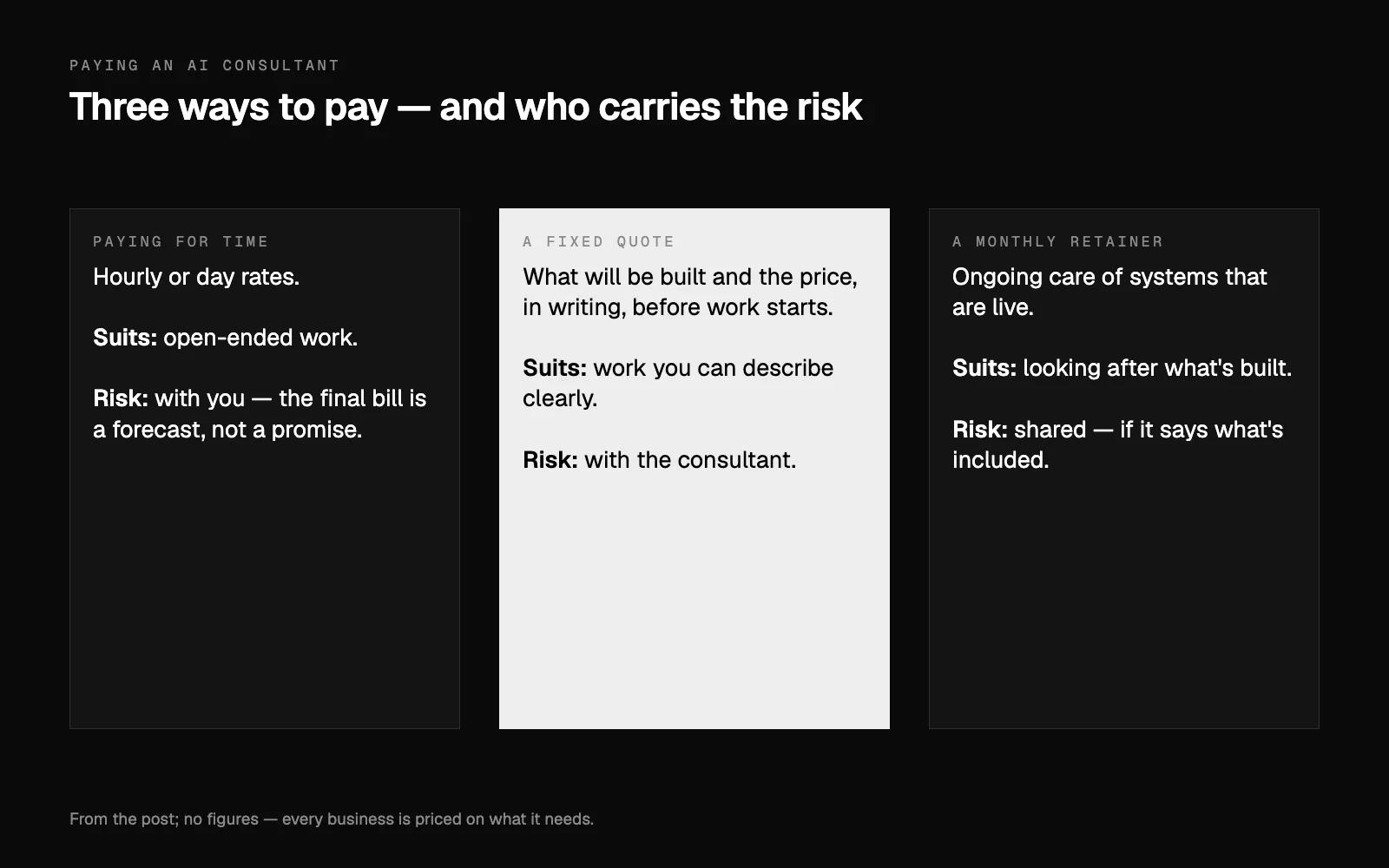
You pay for the hours or days someone works. It's simple, and you only pay for time actually spent.
What it suits: open-ended work, where nobody can say yet what "done" looks like. A workshop with your team, advice on which tools to use, exploring whether an idea is worth building.
Where the risk sits: with you. If the work takes longer than anyone thought, you pay for the extra time. That isn't always unfair, but it means the final bill is a forecast, not a promise.
What to ask:
- How is time recorded, and will you see it as it builds up?
- Is there a cap, and what happens when the work gets close to it?
- Who actually does the work, and are their hours charged the same way?
A fixed quote for a defined piece of work
You agree on what will be built and the price, in writing, before the work starts. If the scope stays the same, the price stays the same.
What it suits: work you can describe clearly. Setting up enquiry replies in your voice, connecting your email and booking system, building one routine that runs every week.
Where the risk sits: with the consultant. If the job takes longer than they expected, that's their problem, not yours. That's why a good fixed quote needs a clear scope: the consultant has to understand your business well enough to stand behind the number.
What to ask:
- What exactly is included, and what isn't?
- What counts as a change, and how is a change quoted?
- What does "finished" mean? Working for a week, a month, or once it's handed over?
- Is it a quote (a fixed price for what's written down) or an estimate (a best guess that can move)?
A monthly retainer
You pay a set amount each month for ongoing work: keeping systems running, fixing what breaks, making them better, reporting on what they did.
What it suits: systems that need looking after once they're live. AI routines change as your services, prices, team and clients change, and someone has to keep them current.
Where the risk sits: it's shared, as long as the retainer says what's included. A vague retainer can mean paying every month for very little.
What to ask:
- What is looked after each month, in plain words?
- How fast do problems get fixed?
- How do you see what was done?
- How do you stop, how much notice is needed, and what do you keep when you leave?
Costs that aren't the consultant's fee
Whichever model you choose, some running costs sit outside it, and it's worth knowing them before you sign:
- Software subscriptions. Your ChatGPT or Claude plan, any add-ons to your booking system, other tools the work relies on.
- Usage. Some AI services charge for how much they're used. Text messages and phone services usually do too.
- Your team's time. Training, answering questions, approving drafts while the system learns your voice.
Ask whose accounts these sit on. They should be yours, so the usage, the costs and the data belong to you rather than to the consultant (how we handle your data).
What the law already gives you
Whichever way the work is priced, the Australian Consumer Law gives you consumer guarantees that apply automatically. Services must be provided with due care and skill, be fit for the purpose you told the provider about, and be finished within a reasonable time when no date was agreed (Consumer Affairs Victoria on the automatic consumer guarantees). A good quote builds on those; it doesn't replace them.
Three things are worth treating as warning signs, whatever the model:
- A price before anyone has looked at how your business runs. Nobody can price work they don't understand yet.
- Systems built on the consultant's own accounts, so leaving means starting again.
- "Unlimited" anything, with no list of what is actually included.
How we price our own work
For what it's worth, here's how we do it. Every job is quoted fixed, in writing, before any work starts. Your first plan costs nothing: eight questions, and a written plan reaches your inbox the same business day, checked by a person. After a 15-minute call you get a fixed quote. There are no lock-ins, and if the scope changes, the quote changes in writing first. Once something is live, looking after it is offered month to month, so you can stop whenever you like.
We don't put prices on our website because no two businesses need the same thing. The answer on our FAQ says the same thing in fewer words.
Questions to ask any AI consultant
Before you hire anyone, us included, ask:
- How will you price this, and why that way?
- What happens if the job turns out bigger or smaller than we thought?
- Whose accounts will the systems run on?
- Who approves anything that goes to my clients?
- Can I switch it off myself, and what do I keep if we part ways?
If the answers are clear and in writing, the pricing model matters less than you'd think. If you want to see what a fixed quote for your business would cover, start with your free AI plan, or book a 15-minute call and ask us these questions directly.
Researched and drafted with AI, and approved by Andrei.
Questions people ask
Why don't you put prices on your website?
Because no two businesses need the same thing, and a number on a page is either too high for a small job or too low for a big one. A 15-minute call and a fixed quote in writing tell you the real figure before any work starts.
Is a fixed quote always better than paying by the hour?
Not always. A fixed quote suits a job you can describe clearly. Paying for time suits open-ended advice or exploring an idea. The risk sits with whoever carries it: you when you pay for time, the consultant when the price is fixed.
What should a monthly retainer include?
A clear list of what is looked after each month, how fast problems get fixed, how you get a report, and how you stop. If it doesn't say how you leave and what you keep, ask before you sign.