
Blog · 11 November 2026
Following up every lead without a sales team
How a small Melbourne business can reply to every enquiry fast and follow up on time with AI, without hiring a salesperson or turning into spam.
By Andrei Satcau · Melbourne

Small businesses rarely lose leads because they're bad at selling. They lose them because nobody had time to reply on a busy Tuesday, and by Thursday the person had booked someone else. One owner told us they used to ring every single lead themselves. It worked, right up until there were more leads than hours in the day.
You don't need a sales team to fix that. You need every enquiry answered quickly, followed up on time, and handed to you when it needs a person. That part can be set up once and then run every day.
Why leads go cold
Leads usually go cold in a few familiar ways.
- The reply comes too late. People often ask more than one business at once. The first clear, useful answer is the one they remember.
- There's one reply and then silence. People get busy. A second and a third friendly nudge isn't pushy; it's good manners.
- Enquiries are scattered. Some come by phone, some by email, some through the website form, some in Instagram or Facebook messages. Nobody sees them all in one place, so some slip through.
- Nobody knows what happened. Did that person book, go elsewhere, or just never hear back? Without a record, you can't tell which ads or pages bring in buyers.
If paid ads bring the leads in, every unanswered enquiry is money spent for nothing. One owner put it as the ads only just covering their spend.
What a follow-up system does
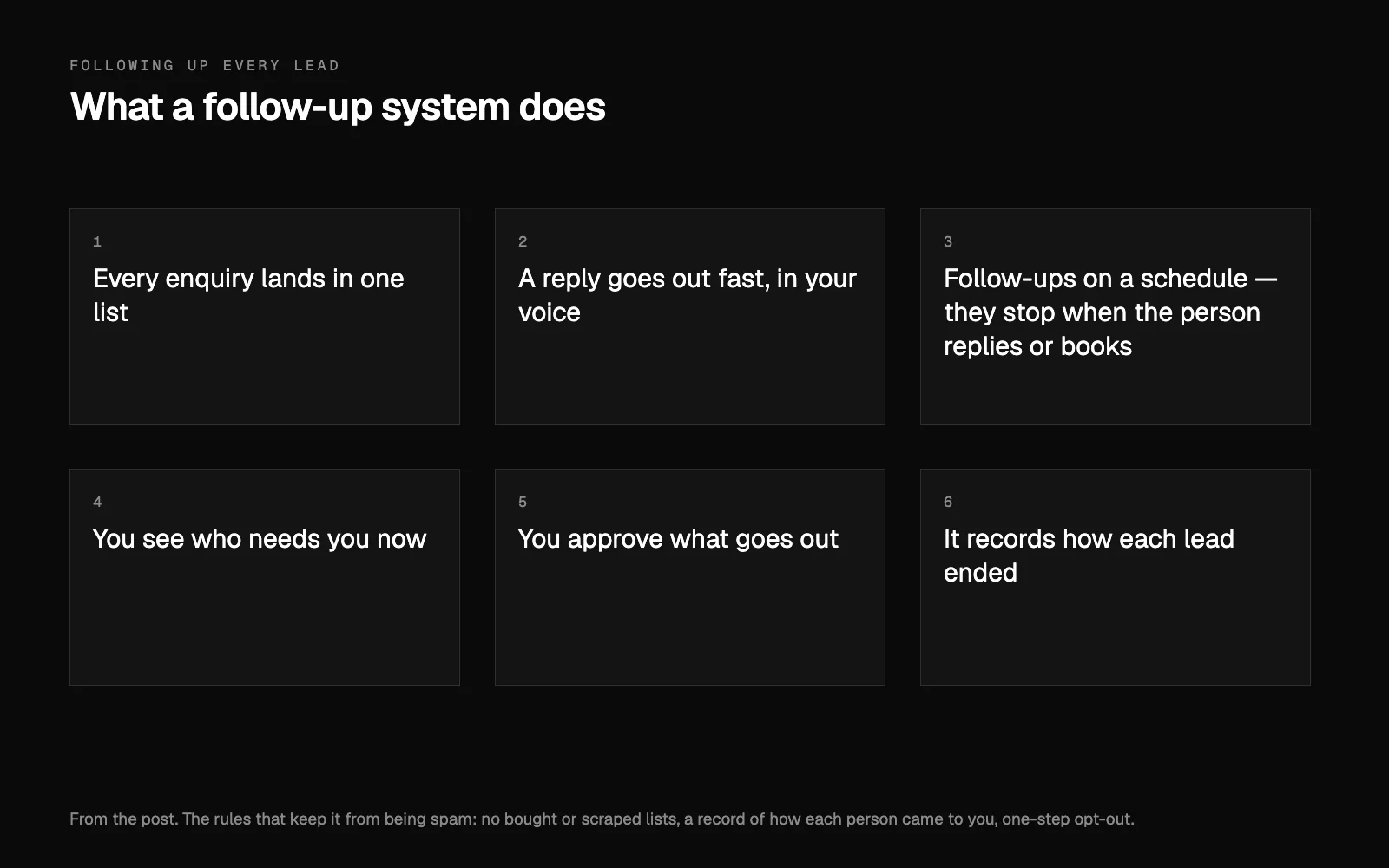
Here is what "following up every lead" looks like when it's set up properly, in plain terms:
- Every enquiry lands in one list. Website form, email, DMs, missed calls with a message: one place, with where each one came from.
- A reply goes out fast, in your voice. It answers the question, gives the useful details and offers the next step, such as your booking link or a time to talk.
- Follow-ups go out on a schedule. The next day, a few days later, a week later, and they stop the moment the person replies or books.
- You see who needs you now. Someone asking for a quote, wanting a call or raising a problem goes straight to you, with the whole conversation attached.
- You approve what goes out. At the start, every message. Once you trust it, the standard replies.
- It records how each lead ended. Booked, not yet, or not interested, so you can see which channels actually bring work.
None of this needs a new piece of software for its own sake. It runs on the email, calendar, files and booking system you already have, connected properly.
What it looks like on our own site
We run our own enquiries this way, so you can see it working before you decide anything. Fill in the plan form on this site and a tailored written plan reaches your inbox the same business day. It's drafted automatically within minutes and checked by a person before anything is promised. You can read how that front office works on our work page.
Since October, every enquiry on this site also records the page it started on and the site that sent the visitor, so we can see which pages bring enquiries instead of guessing. No cookies, nothing the visitor sees changes. It's the same kind of record we'd set up for you.
The rules that keep it from being spam
Following up someone's own enquiry is a conversation they started. Anything beyond that, such as a newsletter, a promotion or a "we miss you" campaign, is marketing, and in Australia the Spam Act applies. The ACMA's rules are short: you need consent first, every message must say who it's from and include your contact details, and unsubscribing must be easy (ACMA: avoid sending spam). You also can't send a message asking for consent, because that message is itself marketing.
In practice that means three things:
- Never buy or scrape lists. They come without consent, and the ACMA puts the burden of proving consent on you.
- Keep a record of how each person came to you, whether it was a form, a booking or a call.
- Let anyone opt out in one step, and respect it straight away.
A good follow-up system does all three by default. That's also why every message should go through your own account and carry your name, not a stranger's platform.
What you still do
AI is good at the repetitive part: the first reply, the reminder, the second nudge, the record. You stay in charge of the parts that need judgement:
- Quotes and anything about money. The system flags the request; you answer it.
- Unhappy clients. They go to a person, fast.
- The offer itself. What you sell, to whom and when stays your call.
- Approval. Nothing goes to a client without your OK until you decide otherwise.
Your data stays yours throughout: stored in Australia, never used to train AI, never shared (how we handle your data).
Where to start
For one week, keep a tally of where your enquiries arrive: phone, email, website, Instagram, Facebook, walk-ins. Write down the five questions people ask most, and how you answer them. That's most of what a follow-up system needs to get going, and it often shows where leads are slipping.
Then answer one channel first, properly, and add the next when the first is running. If the phone is the biggest leak, read what an AI receptionist actually does first.
If you'd like a hand working out which channel to start with, your free AI plan takes eight quick questions and lands the same business day. Rather talk it through? Book a 15-minute call.
Researched and drafted with AI, and approved by Andrei.
Questions people ask
Is an automatic follow-up email spam?
Not when it follows up the person's own enquiry. Marketing on top of that, such as a newsletter or a promotion, needs their consent, has to say who it's from with your contact details, and must make unsubscribing easy.
Will clients know the reply was drafted by AI?
The reply should sound like you, because it's built from your own answers, and a person approves it before it goes. What matters to the client is a fast, accurate answer and a real person when they need one.
Do I need a CRM for this?
Not necessarily. What you need is one list where every enquiry lands, whatever it came through. That can be the tools you already use, set up properly.